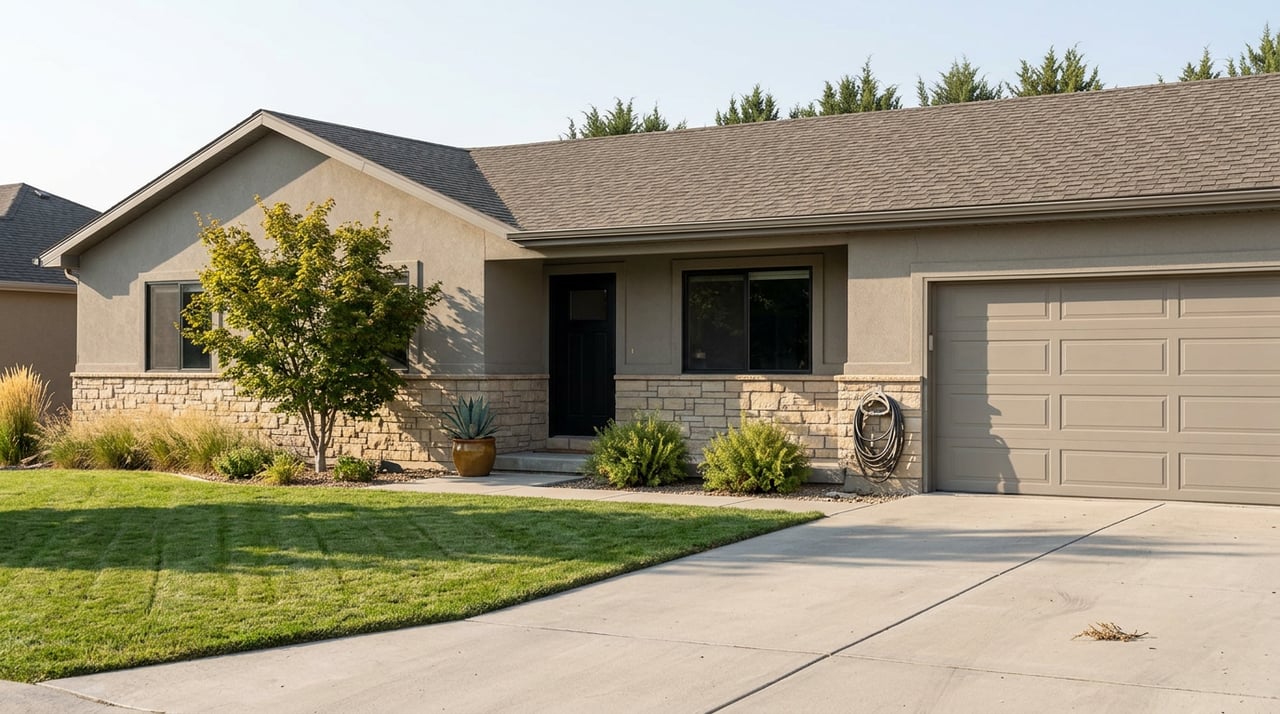
A buyer walks through a nearly finished ranch home in Pueblo West's Eagleridge neighborhood. The floor plan works, the finished basement adds the extra bedroom they wanted, and the builder says they can close in six weeks. What almost never comes up in that conversation is a number the builder doesn't control: how many water taps the Pueblo West Metropolitan District has left to sell this year. That number, not the builder's schedule, is often the real constraint on when a new home in Pueblo West actually gets its water turned on.
Pueblo West runs its own water and wastewater utility, separate from the city of Pueblo next door, and that utility has spent the last several years rationing new connections. Understanding how that rationing works, and what it costs, explains something the sale price alone won't tell you: why new construction in Pueblo West is behaving like a different market than the resale homes sitting a few streets away.
A Utility District Is Deciding How Many New Homes Get Built
The Pueblo West Metropolitan District Board of Directors adopted its first water tap policy in 2022, then extended it in 2025. Under the current version, the district will release just 200 new water taps a year from 2026 through 2029, a total of 800 over four years, handed out in staggered batches rather than all at once.
That cap didn't come from nowhere. In early 2022, the board froze all new building and water-tap applications outright for several weeks while staff studied drought conditions and a possible new water source in Chaffee County. Around the same time, the district's own consultants couldn't agree on how much room actually existed: one estimate from FCS Group put the aquifer's remaining capacity at roughly 2,771 new taps, while a more conservative model from RESPEC put the number closer to 695. The board's response was to split the difference into a multi-year allotment rather than commit to either extreme, and that cautious, ration-it-out approach is the same logic behind the 200-a-year cap running through 2029.
The district's most recent rules update, adopted in 2026, adds a further wrinkle: new water-use monitoring specifically for developments other than single-family homes. Single-family buyers aren't exempt from the overall tap cap, but they are the group the district is watching least closely for consumption once the tap is in the ground. If you're unsure whether a specific build qualifies, the district publishes a flowchart on its site to walk through it.
The Bill That Never Shows Up on the Listing Sheet
The sale price of a new-construction home in Pueblo West doesn't include what it costs to actually connect that home to water and sewer. As of January 1, 2026, those connection fees add up fast for a standard three-quarter-inch setup.
| Fee | Amount |
|---|---|
| Water Plant Investment Fee | $19,609 |
| Water Resource Fee | $5,960 |
| Water tap fee (parts and labor) | $1,663.97 |
| Water connection subtotal | $27,232.97 |
| Wastewater Plant Investment Fee | $7,425 |
| Wastewater tap fee | $671.39 |
| Wastewater connection subtotal | $8,096.39 |
| Combined total | $35,329.36 |
That's before the home is even occupied. Once it is, the household pays ongoing readiness-to-serve charges of $28.72 a month for water and $41.48 a month for sewer, plus a newer $1.50 monthly fee the district added in 2025 to cover residential service line repairs between the main and the meter.
There's also a clock attached to the tap itself. Once a building permit is issued, the builder has 120 days to pour the foundation or the tap allocation can be lost. Before that, the permit itself has to be pulled within 60 days of Committee of Architecture approval. For a buyer under contract on a spec home, none of these deadlines are optional, and none of them are the builder's to control if the district's staggered tap releases run behind schedule.
Two Markets, One Zip Code
This is where the numbers stop agreeing with each other, and that disagreement is the point.
In a 30-day window ending in mid-April 2026, the market tracker Orchard showed price per square foot in Pueblo West up 8.8 percent year over year, even as only 11 homes sold in that stretch, down from 28 the year before. Active inventory was up 12 percent year over year to 159 listings, the median sale-to-list ratio had slipped to 96.39 percent, and just over half of all listings, 54.55 percent, had taken a price cut at some point.
That divergence didn't resolve itself over the summer. Redfin's July 2026 snapshot put the average sale price at $405,000, down 10 percent from a year earlier, and scored the overall market just 34 out of 100 for competitiveness. Movoto's July numbers told a similar story on the list side: median list price down to $420,000, a 5 percent drop from June and 4 percent from a year earlier, with homes sitting a median 92 days before going under contract.
Meanwhile, new construction hasn't followed the resale market down. Right now, Redfin counts just 12 active new-construction listings in Pueblo West, carrying a median list price of $440,000, well above the broader resale median. New Home Source currently shows only one builder actively developing a dedicated new-home community in Pueblo West.
A market with 159 homes for sale and a district-capped supply of 200 new taps a year isn't one market. It's two, priced differently, for a structural reason that has nothing to do with buyer demand.
What This Means If You're Comparing a Spec Home to a Resale Listing
Westover Homes currently has a community in Pueblo West with 19 homes priced between $400,000 and $450,000, including 11 move-in ready and three additional floor plans still to be built. Western Ridge Homes, a locally owned custom and spec builder based in Pueblo, is another option for buyers who want to build rather than buy off a plan. Beyond those two, most of the new construction on the market is one-off spec building on individual acreage lots rather than production-style neighborhoods. Search activity for new construction tends to cluster around the Ridge, Hyde Park, and Sky View areas.
If you're looking at a spec home, ask the builder directly where their project sits in the district's current tap allotment and whether the tap has already been secured. A home marketed as move-in ready should already have cleared that hurdle. A home still under construction, especially one just breaking ground, is more exposed to the 120-day foundation deadline and to the possibility that the district's current-year tap batch runs out before the framing is done.
If you're looking at resale instead, none of the tap math applies to you directly, since the connection already exists. What does apply is the leverage the resale data points to: with over half of listings taking price cuts and average sale prices down double digits year over year, sellers in that segment are negotiating from a softer position than the new-construction numbers would suggest for the market as a whole.
A Few Questions Worth Asking Early
Does the tap cap affect people buying an existing home? No. The cap governs new connections only. A resale home in Pueblo West already has an active tap and account with the district, so this policy has no bearing on that transaction.
What happens if a builder misses the 120-day foundation deadline? The district's policy ties tap allocation to that window. Missing it can mean losing the tap that was reserved for the project, which pushes the build back into whatever allotment the district has left to release that year.
Is the district likely to raise the 200-tap limit before 2029? Nothing in the current policy suggests that. The board extended the cap through 2029 specifically to manage a water supply that its own consultants gave a wide range of estimates on, and the district's pattern since 2022 has been toward caution rather than expansion.
Whether you're weighing a spec home against a resale listing or just trying to make sense of why the numbers in Pueblo West don't add up the way they do in Fountain or Colorado Springs, it helps to have someone walk through the actual mechanics with you before you write an offer. Ashley Moberly works with buyers across Pueblo West and the surrounding communities and can talk through what a specific builder's timeline or a specific resale listing's price history actually means for your decision. Let's Connect.
